Bitcoin: If currency crashed, plunge would harm its investors but not economy
Adam Shell, USA TODAYPublished 6:00 a.m. ET Jan. 23, 2018 | Updated 9:26 a.m. ET Jan. 23, 2018
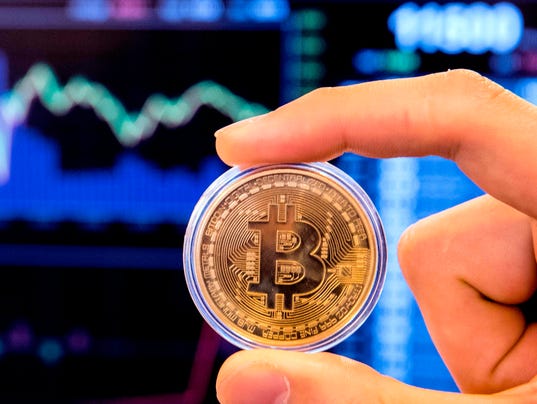
Bitcoin slid to $10,000 on Wednesday for the first time since Dec. 1, leaving the cryptocurrency down by close to half from its peak hit last month. Newslook
If bitcoin, which skeptics say is a bubble, suffers the same fate as past financial manias, look out below.
Fears of a bitcoin crash are growing amid an early-year plunge that has wiped out 50% of the digital currency's value since its December peak of $19,500 per coin.
"There is significant precedent to suggest that the more rapid the appreciation, the more rapid the depreciation," says Scott McGann, a finance lecturer at San Diego State University.
Bitcoin's wild ride continued Monday when it was down more than 11% at $10,050 after cratering last week to a seven-week low of $9,200.
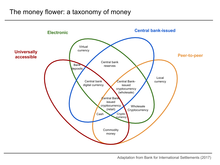
Taxonomy of money, based on "Central bank cryptocurrencies"by Morten Linnemann Bech and Rodney Garratt.
"E-cash" redirects here. For the 20th century brand, see ecash.
Digital currency (digital money or electronic money or electronic currency) is a type of currency available only in digital form, not in physical (such as banknotes and coins). It exhibits properties similar to physical currencies, but allows for instantaneous transactions and borderless transfer-of-ownership. Examples include virtual currencies and cryptocurrencies[1] or even central bank issued "digital base money". Like traditional money, these currencies may be used to buy physical goodsand services, but may also be restricted to certain communities such as for use inside an on-line game or social network.[2]
Digital currency is a money balance recorded electronically on a stored-value card or other device. Another form of electronic money is network money, allowing the transfer of value on computer networks, particularly the Internet. Electronic money is also a claim on a private bank or other financial institution such as bank deposits.[3]
Digital money can either be centralized, where there is a central point of control over the money supply, or decentralized, where the control over the money supply can come from various sources.
This is a question that often causes confusion. Here's a quick explanation!
The basics for a new user
As a new user, you can get started with Bitcoin without understanding the technical details. Once you have installed a Bitcoin wallet on your computer or mobile phone, it will generate your first Bitcoin address and you can create more whenever you need one. You can disclose your addresses to your friends so that they can pay you or vice versa. In fact, this is pretty similar to how email works, except that Bitcoin addresses should only be used once.
Balances - block chain
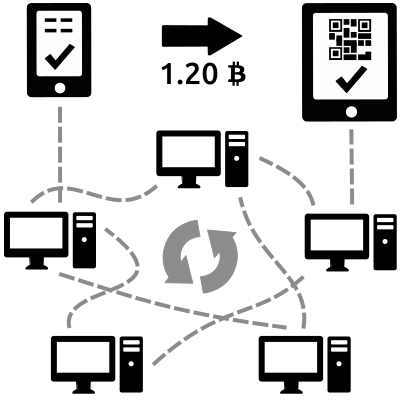
The block chain is a shared public ledger on which the entire Bitcoin network relies. All confirmed transactions are included in the block chain. This way, Bitcoin wallets can calculate their spendable balance and new transactions can be verified to be spending bitcoins that are actually owned by the spender. The integrity and the chronological order of the block chain are enforced with cryptography.
Transactions - private keys
A transaction is a transfer of value between Bitcoin wallets that gets included in the block chain. Bitcoin wallets keep a secret piece of data called a private key or seed, which is used to sign transactions, providing a mathematical proof that they have come from the owner of the wallet. The signature also prevents the transaction from being altered by anybody once it has been issued. All transactions are broadcast between users and usually begin to be confirmed by the network in the following 10 minutes, through a process called mining.
Processing - mining
Mining is a distributed consensus system that is used to confirm waiting transactions by including them in the block chain. It enforces a chronological order in the block chain, protects the neutrality of the network, and allows different computers to agree on the state of the system. To be confirmed, transactions must be packed in a block that fits very strict cryptographic rules that will be verified by the network. These rules prevent previous blocks from being modified because doing so would invalidate all following blocks. Mining also creates the equivalent of a competitive lottery that prevents any individual from easily adding new blocks consecutively in the block chain. This way, no individuals can control what is included in the block chain or replace parts of the block
Bitcoin is a form of digital currency, created and held electronically. No one controls it. Bitcoins aren’t printed, like dollars or euros – they’re produced by people, and increasingly businesses, running computers all around the world, using software that solves mathematical problems.
It’s the first example of a growing category of money known as cryptocurrency.
What makes it different from normal currencies?
Bitcoin can be used to buy things electronically. In that sense, it’s like conventional dollars, euros, or yen, which are also traded digitally.
However, bitcoin’s most important characteristic, and the thing that makes it different to conventional money, is that it is decentralized. No single institution controls the bitcoin network. This puts some people at ease, because it means that a large bank can’t control their money.
Who created it?
A software developer called Satoshi Nakamoto proposed bitcoin, which was an electronic payment system based on mathematical proof. The idea was to produce a currency independent of any central authority, transferable electronically, more or less instantly, with very low transaction fees.
Who prints it?
No one. This currency isn’t physically printed in the shadows by a central bank, unaccountable to the population, and making its own rules. Those banks can simply produce more money to cover the national debt, thus devaluing their currency.
Instead, bitcoin is created digitally, by a community of people that anyone can join. Bitcoins are ‘mined’, using computing power in a distributed network.
This network also processes transactions made with the virtual currency, effectively making bitcoin its own payment network.